
Management
Managing with the Enneagram
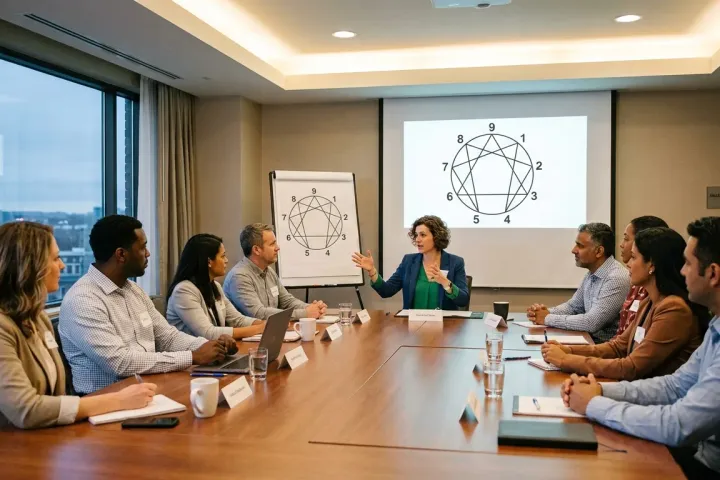
The Enneagram describes nine ways of being motivated, and nine things that reliably go wrong under pressure. One day to recognise your own profile, read your team's, and stop managing everyone as though they wanted what you want.
What you will be able to do
- Know the 9 bases of the Enneagram
- Know your own personality base in the Enneagram
- Know the base of each of your direct reports
- Give feedback adapted to each personality base
- Adapt your delegation to each base
- Motivate each person according to their personality
Programme
A reminder of each participant's Enneagram base
- The vocabulary of the Enneagram
- The main characteristics, strengths and areas for improvement of each base
Which profiles make up my team?
- Identifying the profiles around me, and which ones dominate
- Drawing on other tools and methods, depending on the trainer's certification
- Involving the team member in determining their own profile
Managing each base
- Communicating and giving feedback with each profile
- Coaching, motivating, setting the frame and correcting with each profile
- The strengths to build on
- Each base's relationship to authority
Keeping the Enneagram alive in the team
- Ideas and tips for making it last
What is the Enneagram?
It is a method for studying personality, based on nine patterns of human behaviour. It is a tool for getting to know yourself better, and so for getting to know others better.
What this course gives you
- A better understanding of yourself and your personality, and of your team members’, to improve individual relationships and teamwork
- The ability to recognise your team members’ profiles and to practise individualised, tailored management
- Adapting the toolkit you are given to each team member’s profile, and drawing on individual characteristics to strengthen the team as a whole
- Identifying all the profiles in your team and making the most of the complementarity between their personality bases
Questions about this course
Is the Enneagram a scientific instrument?
No, and we say so in the room. It is a model for describing motivation, not a psychometric measure with published validity. What makes it useful in management is that people recognise themselves in it and it gives a team shared vocabulary for differences they were already feeling. We use it as a lens, never as a selection or assessment tool.
Do participants complete a questionnaire?
Yes, before the session, and the debrief happens during the day. Individual results belong to the participant. Nothing is reported back to the employer, and no profile is recorded in an HR file — that condition is what makes people answer honestly.
We already use DISC. Does this conflict with it?
They answer different questions. DISC describes observable behaviour and is the faster tool for adapting a conversation in the moment. The Enneagram describes underlying motivation and is the better tool for understanding why someone is disengaged or repeatedly reacts the same way. Teams that use both tend to use DISC daily and the Enneagram for the harder individual cases.
Can the Enneagram be used for recruitment?
No, and we advise firmly against it. The Enneagram does not assess a competence and does not predict performance; using it in selection means ruling candidates out on a criterion with no predictive validity. It is for working better with the people already in the team.
Related courses

The manager-leader toolkit
The core management programme. Three days covering the work a manager actually does day to day — setting the frame, delegating, running one-to-ones, handling the conversation nobody wants to have. The third day comes a few weeks later, once the tools have met a real team.

Motivating without a budget
Most managers have far less control over pay than over the things that actually drive engagement. This course covers the non-financial levers — autonomy, recognition, visible progress, meaning — and how to tell which one a given person responds to.

Managing hybrid and distributed teams
When part of the team works from another island, from home or from a head office abroad, the office routine does not travel on its own. One day on the rules to set from the start, clear objectives, rituals that hold, and feedback and one-to-ones at a distance.